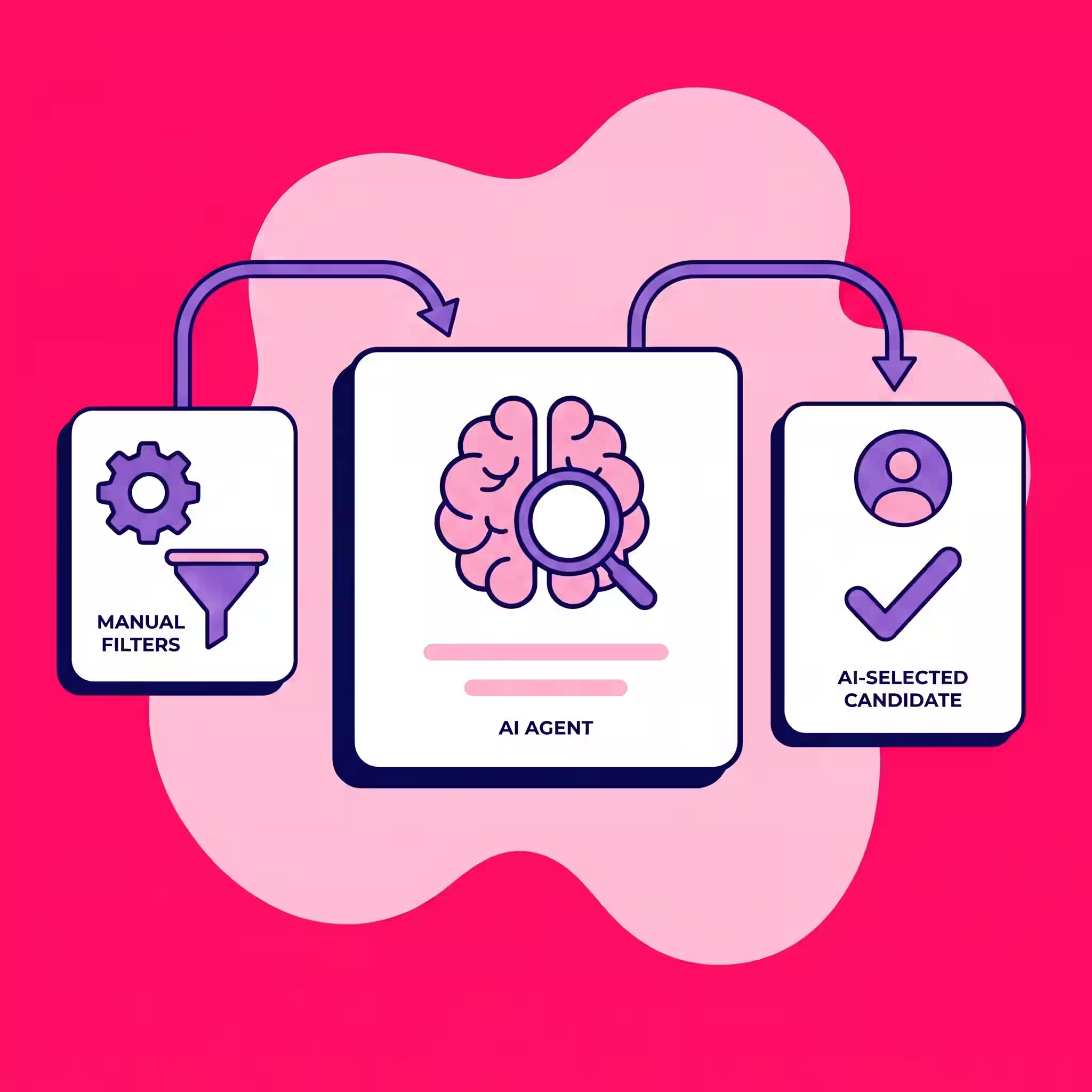

Recruiting search hasn’t changed much in twenty years. Recruiters still open a sourcing tool, set dozens of filters, write Boolean strings, and scroll through pages of results hoping to find candidates who actually fit. The process is slow, manual, and heavily dependent on the recruiter’s ability to translate a hiring manager’s wish list into the right combination of keywords.
That changes now. GoPerfect’s agentic search is a fundamentally different approach to candidate sourcing. Instead of operating a search tool, recruiters describe what they’re looking for in plain language—and an AI agent autonomously builds the search, applies filters, scores candidates semantically, and returns a ranked shortlist with match relevance close to 100%.
This isn’t a better search bar. It’s the end of recruiter-operated search entirely.
What Is Agentic Recruiting Search?
Agentic recruiting search means the AI doesn’t just assist with sourcing—it runs the entire search autonomously. The recruiter’s role shifts from building queries to evaluating results.
In GoPerfect’s agentic search, the process works like this: a recruiter describes their ideal candidate in natural language (“I need a senior backend engineer with fintech experience, ideally from a Series B or later startup, based in New York or open to remote”). The AI agent then autonomously translates that description into a structured, multi-layered search across 800M+ candidate profiles.
The recruiter never touches a filter. They never write a Boolean string. They describe what they want, and the AI handles the rest.
How GoPerfect’s Three-Tier Search Works
What makes GoPerfect’s agentic search different from a simple AI-assisted filter is the three-tier architecture that runs autonomously behind every query.
Tier 1: Hard Filters (Pool Control)
The first tier applies absolute requirements. These are non-negotiable criteria that determine who appears in the results at all. GoPerfect uses two mechanisms here: Must-Have gates, where a candidate must match or they’re excluded entirely, and Exclusion blocks, where matching candidates are removed from the pool. Examples include “Must have 5+ years of experience” or “Exclude candidates currently at Company X.”
Hard filters control the size of the candidate pool. They ensure every result meets the baseline requirements before any ranking takes place.
Tier 2: Weighted Semantic Preferences (Ranking)
Once the pool is defined, the AI scores and ranks every remaining candidate using weighted semantic preferences. This tier uses two priority levels: Important criteria, which carry roughly 60% of the ranking weight and give a strong boost to matching candidates, and Preferred criteria, which carry roughly 40% weight and help break ties between similarly qualified people.
Critically, candidates who don’t match Important or Preferred criteria are still shown—they’re just ranked lower. This means recruiters don’t accidentally eliminate strong candidates who happen to miss one flexible preference.
The semantic matching engine understands related terms, not just exact keywords. Searching for “Machine Learning” also surfaces candidates with “Deep Learning,” “Neural Networks,” or “Computer Vision” experience. This alone eliminates one of the biggest problems with traditional Boolean search: missing qualified candidates because they used different terminology on their profile.
Tier 3: Discovery Candidates
This is the tier that doesn’t exist in any traditional sourcing tool. GoPerfect’s AI surfaces discovery candidates—people who wouldn’t appear in a Boolean search but whose career trajectory, skills combination, or background makes them a strong fit for the role.
Discovery candidates are the recruiters and hiring managers who say “I never would have thought to look for this person, but they’re perfect.” Boolean search can’t do this because it only returns exact matches to the query you wrote. Agentic search understands the intent behind the role and finds people who match that intent, even if their profile doesn’t contain the expected keywords.
Why This Matters: The Numbers Behind Agentic Search
The industry standard candidate acceptance rate—the percentage of sourced candidates who actually move forward in the hiring process—sits at roughly 29%. That means more than two out of three candidates sourced through traditional methods don’t work out. Recruiters spend hours finding people, writing outreach, and waiting for replies, only for the majority to be a poor fit.
GoPerfect customers already achieve a 55% acceptance rate—nearly double the industry average. Agentic search is designed to widen that gap further by delivering match relevance close to 100%. When every candidate on the shortlist is genuinely relevant, recruiters stop wasting time on screening and start spending it on what actually matters: interviewing and closing the right people.
Agentic Search vs. Boolean Search: What’s Actually Different
Boolean search has been the backbone of recruiting sourcing for decades. It works by matching exact keywords and logical operators (AND, OR, NOT) against candidate profiles. It’s powerful in theory, but in practice it has serious limitations.
Boolean search only finds what you explicitly ask for. If your ideal candidate describes their experience differently than your query, they’re invisible. It requires deep expertise to write effective strings—junior recruiters routinely miss great candidates because their Boolean isn’t precise enough. And it has zero ability to surface candidates you didn’t know to search for.
Agentic search solves all three problems. It uses semantic matching to understand meaning rather than keywords. It requires no technical search expertise—the recruiter just describes the role. And it autonomously discovers candidates that fall outside the explicit query but match the underlying intent of the hire.
The shift is fundamental: Boolean search is a tool you operate. Agentic search is an agent that works for you.
What This Means for Recruiting Teams
For TA leaders, agency owners, and recruiters who source candidates daily, agentic search changes the workflow entirely. The time previously spent building searches, tweaking filters, and scrolling through irrelevant results is gone. That time is now spent evaluating a shortlist of candidates the AI has already vetted for relevance.
For recruiting agencies, this is a direct throughput multiplier. Faster sourcing with higher match quality means more submittals per week, shorter time-to-fill, and more placements. For in-house teams, it means recruiters can handle a higher req load without sacrificing quality—because the AI is doing the sourcing heavy lifting.
And the system gets smarter with use. Results improve with every interaction as the AI learns what each recruiter and role actually needs.
Frequently Asked Questions
What is agentic recruiting search?
Agentic recruiting search is an AI-driven approach to candidate sourcing where an autonomous agent runs the entire search process. Instead of manually setting filters and writing Boolean queries, the recruiter describes their ideal candidate and the AI builds the search, applies filters, scores candidates semantically, and returns a ranked shortlist. GoPerfect’s agentic search operates across three tiers: hard filters, weighted semantic preferences, and discovery candidates.
How is agentic search different from AI-assisted search?
AI-assisted search tools still require the recruiter to build and manage the search manually—the AI might suggest keywords or auto-complete filters, but the human is still in the driver’s seat. Agentic search is fully autonomous: the recruiter provides the input (a description of the ideal candidate) and the AI agent handles everything else, including discovering candidates the recruiter wouldn’t have found through any manual query.
What does “match relevance close to 100%” mean?
It means that nearly every candidate returned in an agentic search result is genuinely relevant to the role. Traditional search tools return a mix of strong and weak matches, forcing recruiters to manually screen results. GoPerfect’s three-tier system applies hard filters to set the baseline, then uses semantic scoring to rank by fit, delivering a shortlist where virtually every candidate is worth the recruiter’s time.
What are discovery candidates?
Discovery candidates are people the AI surfaces who wouldn’t appear in a traditional keyword or Boolean search. Their career trajectory, skills combination, or background makes them a strong fit for the role, but their profile doesn’t contain the specific terms a recruiter would have searched for. This is one of the most powerful advantages of agentic search over traditional sourcing methods.
Does agentic search work with my ATS?
GoPerfect integrates with 60+ applicant tracking systems through Merge, including Greenhouse, Lever, JazzHR, BambooHR, Workday, Ashby, iCIMS, Bullhorn, and more. Agentic search is part of GoPerfect’s outbound sourcing engine, which works alongside inbound screening and autonomous outreach to cover the full recruiting pipeline.
How does semantic matching work in recruiting search?
Semantic matching understands the meaning behind terms rather than matching exact keywords. When a recruiter searches for “Machine Learning,” GoPerfect’s engine also finds candidates with experience in “Deep Learning,” “Neural Networks,” “Natural Language Processing,” and related fields. This applies to skills, industries, education fields, and certifications—dramatically expanding the pool of qualified candidates compared to keyword-based search.
See Agentic Search in Action
GoPerfect’s agentic search is live now. If you’re a TA leader, recruiter, or agency owner who’s tired of building Boolean strings and scrolling through irrelevant results, see what happens when AI runs your search for you.
Want to see agentic search in action? Book a quick demo.

Start hiring faster and smarter with AI-powered tools built for success


