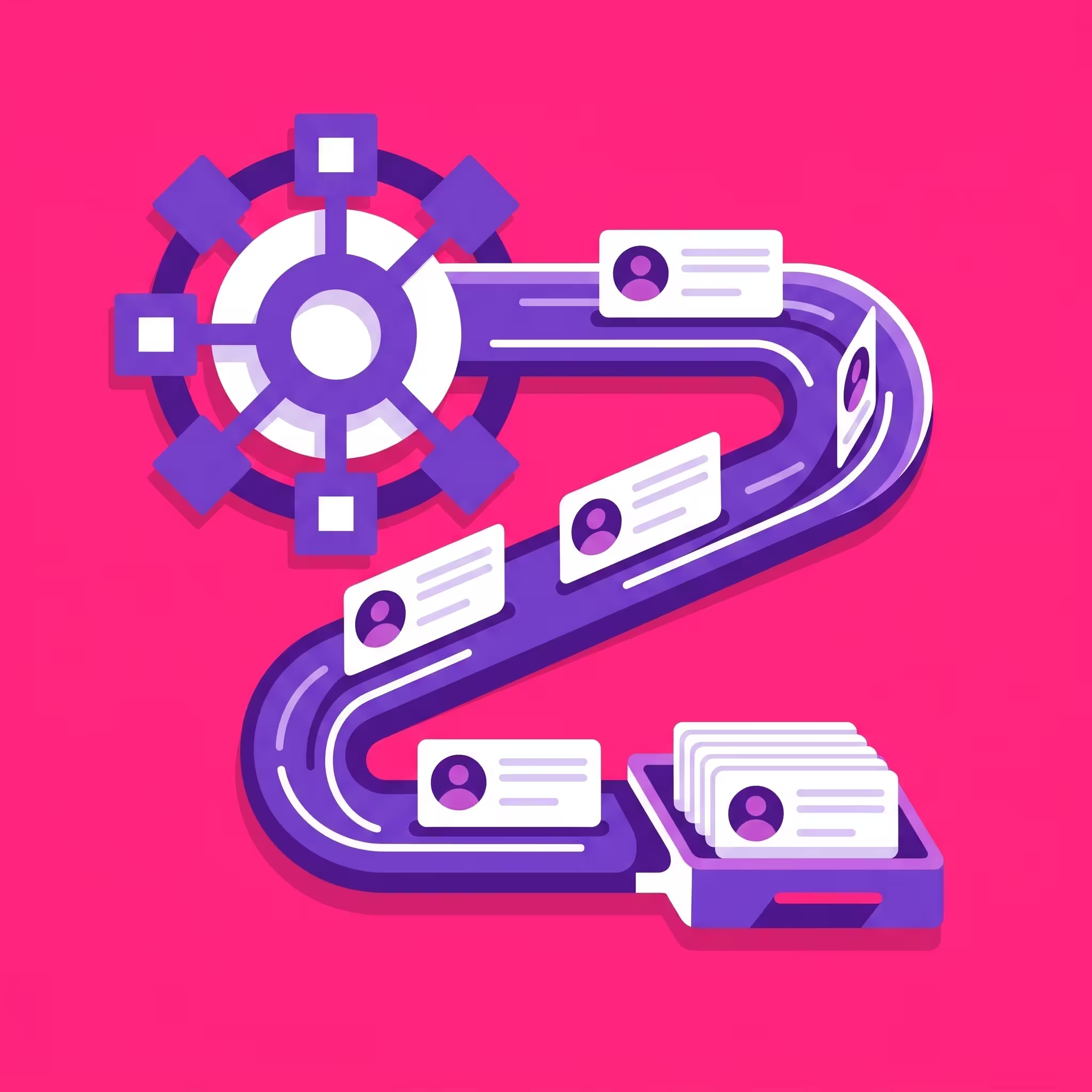

How AI Tools Improve Candidate Sourcing Efficiency
Candidate sourcing has always been the most time-consuming stage of the recruiting process. Recruiters spend an average of 13 hours per week sourcing candidates for a single role, according to research from Entelo—scrolling through profiles, writing outreach messages, managing spreadsheets, and chasing replies that never come. Multiply that across five, ten, or fifty open requisitions, and sourcing quickly becomes the bottleneck that slows every hire.
AI-powered sourcing tools are fundamentally changing this equation. By automating the most repetitive and labor-intensive parts of candidate discovery, matching, and outreach, AI enables recruiters to build qualified pipelines in minutes instead of days—without sacrificing quality. Organizations using AI-supported sourcing report up to a 30% reduction in time-to-fill and a 30–40% drop in cost-per-hire, while 69% of talent acquisition professionals say AI sourcing produces higher-quality candidates overall.
This article explains exactly how AI tools improve candidate sourcing efficiency, what specific capabilities matter most, where the technology delivers the biggest ROI, and how to implement AI sourcing in a way that augments your team rather than replacing human judgment.
The Sourcing Problem: Why Traditional Methods No Longer Scale
Before examining the AI solution, it is worth understanding why traditional sourcing has hit a ceiling. Several forces are making manual sourcing harder and less effective every year:
- Volume and velocity: Hiring demands are growing, but recruiting headcount is not. Teams are expected to fill more roles, faster, with the same or fewer resources. Manual sourcing simply cannot keep pace.
- Passive candidate dominance: The strongest candidates are rarely actively looking for jobs. Reaching them requires proactive outreach across multiple channels—LinkedIn, email, professional communities—which is enormously time-consuming when done manually.
- Data fragmentation: Candidate information is scattered across job boards, ATS databases, social networks, internal records, and personal spreadsheets. Recruiters waste hours searching across platforms and deduplicating profiles.
- Quality vs. quantity tradeoff: When recruiters are under pressure to fill pipelines quickly, quality often suffers. Manual keyword searches return large, noisy result sets that require extensive filtering—and the best-fit candidates are often buried or missed entirely.
- Outreach fatigue: Generic, high-volume outreach damages employer brand and drives down response rates. But personalizing messages at scale requires time most recruiters do not have.
AI sourcing tools address each of these problems by automating the high-volume, low-judgment work that consumes most of a recruiter’s sourcing time, and delivering better results in the process.
6 Ways AI Tools Improve Candidate Sourcing Efficiency
1. Automated Candidate Discovery Across Multiple Channels
The most immediate impact of AI sourcing tools is the ability to search across massive talent databases, job boards, professional networks, and internal ATS records simultaneously—in seconds rather than hours. Instead of a recruiter manually running searches on LinkedIn, then Indeed, then their ATS, then their referral database, AI scans all of these sources at once and returns a unified, deduplicated list of candidates who match the role.
Modern AI sourcing platforms like GoPerfect go a step further by using natural language processing (NLP) to interpret job requirements and translate them into sophisticated search queries automatically. Rather than requiring recruiters to write complex Boolean strings, GoPerfect lets teams describe what they need in plain language and surfaces relevant candidates from large talent pools within minutes. This is especially valuable for staffing agencies managing dozens of requisitions across different industries and role types simultaneously.
2. Intelligent Candidate Matching and Ranking
Traditional keyword-based search is inherently limited. It matches exact terms but misses qualified candidates who use different language to describe the same skills, or who have relevant experience that does not map neatly to the keywords in a job description. AI matching algorithms analyze patterns in candidate profiles—skills, career trajectories, education, industry experience, and contextual signals—to identify the best fits, even when the exact keywords do not match.
This means recruiters spend less time wading through irrelevant results and more time engaging with candidates who are genuinely qualified. Research from Korn Ferry found that 69% of talent acquisition professionals reported higher-quality candidates when using AI-powered matching as part of their sourcing workflow.
AI ranking also improves over time. As recruiters provide feedback on which candidates advanced or were rejected, the algorithm learns and refines its recommendations, making each subsequent search more accurate.
3. Personalized Outreach at Scale
Sourcing does not end with finding candidates—it requires engaging them. For passive candidates, the outreach message is often the only chance a recruiter has to make a first impression. Generic copy-paste messages have low response rates, but writing personalized outreach for every candidate is not feasible when you need to contact dozens or hundreds of people per role.
AI solves this by automating personalized outreach sequences that tailor messaging based on each candidate’s profile, skills, and background. GoPerfect automates this entire workflow: once the AI identifies matching candidates, it generates and sends personalized outbound sequences across email and LinkedIn—at scale—without requiring the recruiter to manually draft each message. The result is higher response rates, warmer candidate conversations, and significantly less recruiter time spent on repetitive outreach.
4. Rediscovery of Existing Talent Pools
One of the most overlooked sourcing inefficiencies is the failure to leverage candidates already in your database. Most organizations have thousands of past applicants, silver medalists, and sourced profiles sitting in their ATS—many of whom may be a strong fit for new roles. But without AI, these records are difficult to search, poorly organized, and quickly forgotten.
AI-powered rediscovery tools scan your existing database and match past candidates to current openings, surfacing strong fits that would otherwise require a net-new search. This reduces time-to-fill, lowers cost-per-hire, and improves the candidate experience by re-engaging people who have already expressed interest in your organization.
5. Reduced Bias in the Sourcing Stage
Human sourcing is inherently influenced by unconscious bias—the networks recruiters search, the profiles they click on, and the language they respond to are all shaped by individual patterns and preferences. AI sourcing tools can reduce this bias by applying consistent, objective criteria to every candidate evaluation and surfacing diverse talent that manual searches might overlook.
This is not automatic, however. The quality of AI-driven diversity depends entirely on the training data and the design of the algorithm. Organizations implementing AI sourcing should audit their tools for bias regularly, ensure that matching criteria prioritize skills and outcomes over proxies like school name or employer prestige, and maintain human oversight of all sourcing recommendations. When implemented thoughtfully, AI sourcing can be a powerful lever for building more inclusive pipelines.
6. Real-Time Analytics and Pipeline Visibility
AI sourcing tools do not just find candidates—they generate data on every step of the sourcing process. This includes which channels produce the most qualified candidates, what outreach messages drive the highest response rates, how long it takes to move candidates from sourced to screened, and where pipelines are stalling.
This real-time visibility allows recruiting leaders to make data-informed decisions about where to invest their team’s time and budget. Instead of guessing which job boards or outreach strategies are working, managers can optimize based on actual conversion data—continuously improving sourcing efficiency over time.
The Measurable Impact of AI on Sourcing Metrics
The efficiency gains from AI sourcing are well-documented across the industry:
- Time-to-fill: SHRM reports that recruiters using AI-supported sourcing reduce time-to-fill by up to 30%. Some organizations have compressed sourcing timelines from weeks to days—Unilever, for example, shortened its recruitment cycle from four months to four weeks after adopting AI-driven sourcing and screening.
- Cost-per-hire: Organizations aligning AI recruiting tools with clear objectives report a 30–40% drop in cost-per-hire, according to IQTalent’s 2026 research. Unilever’s AI adoption reduced hiring costs by 50%.
- Recruiter productivity: AI automation frees up three to five hours per day of recruiter time that was previously spent on manual sourcing tasks, translating to a 41% increase in recruiting efficiency (Entelo).
- Quality of hire: 69% of talent acquisition professionals report higher-quality candidates when using AI sourcing tools (Korn Ferry). Better matching upfront means fewer bad hires and lower early turnover.
- Diversity: Organizations using purpose-built AI recruiting tools report up to a 48% increase in diversity hiring effectiveness (IQTalent, 2026).
How GoPerfect Uses AI to Transform Candidate Sourcing
GoPerfect is an AI-powered recruiting platform purpose-built to solve the sourcing efficiency problem. It combines several of the AI capabilities described above into a single, integrated workflow:
- AI-powered candidate identification: GoPerfect scans large talent databases and matches candidates to role requirements using advanced AI algorithms, delivering qualified candidate lists in minutes rather than days.
- Automated outbound recruiting: Once candidates are identified, GoPerfect generates and sends personalized outreach sequences across email and LinkedIn automatically—no manual drafting required.
- Multi-channel engagement: Candidates are reached across the channels where they are most likely to respond, with sequencing and follow-ups handled by the platform.
- Built for both staffing agencies and in-house teams: GoPerfect serves staffing agencies with two or more recruiters and companies with in-house recruiting teams of 500 to 5,000 employees—organizations that need to scale sourcing output without proportionally scaling headcount.
The result is a sourcing engine that delivers more qualified candidates, faster, at a lower cost per hire—while freeing recruiters to focus on the high-value activities that require human judgment: evaluating cultural fit, building relationships, and closing top candidates.
What AI Cannot Replace: The Human Side of Sourcing
While AI dramatically improves sourcing efficiency, it does not—and should not—replace the recruiter. The most effective sourcing strategies combine AI automation with human expertise in several critical areas:
- Relationship building: AI can initiate contact, but trust is built through genuine human conversation. The recruiter’s ability to listen, advise, and connect on a personal level is what converts a sourced candidate into an engaged applicant.
- Contextual judgment: AI evaluates what is in a profile. Recruiters evaluate what is not—career motivations, cultural fit, team dynamics, and timing. These factors are often decisive and cannot be fully captured in data.
- Candidate experience: Only 26% of applicants trust AI to evaluate them fairly (Gartner, 2026). Visible human oversight and transparent communication about how AI is used are essential for maintaining candidate trust.
- Bias oversight: AI can reduce bias, but it can also encode it. Human review of AI sourcing recommendations is necessary to catch patterns the algorithm may miss and ensure that sourcing criteria are fair and inclusive.
The best-performing recruiting teams in 2026 treat AI as a force multiplier, not a replacement. They use AI to do the heavy lifting of candidate discovery and outreach, then invest their freed-up time in the conversations and decisions that determine whether a good candidate becomes a great hire.
How to Implement AI Sourcing: A Practical Guide
If your team is considering AI sourcing tools, here is how to approach implementation for maximum impact:
- Start with clear objectives: Define what success looks like before evaluating tools. Are you trying to reduce time-to-fill? Lower cost-per-hire? Improve pipeline diversity? Specific goals drive better tool selection and measurable ROI.
- Audit your current process: Map your existing sourcing workflow from end to end. Identify which steps consume the most recruiter time and where quality is most likely to drop. These are your highest-ROI automation opportunities.
- Pilot on a defined scope: Start with a single team, role type, or geographic market. Test the tool against your baseline metrics before rolling out broadly.
- Integrate with your existing stack: AI sourcing tools deliver the most value when they integrate seamlessly with your ATS, CRM, and communication platforms. Data should flow automatically—not require manual import/export.
- Train your team: AI tools are most effective when recruiters understand how they work, what they can and cannot do, and how to provide feedback that improves the algorithm over time.
- Measure and iterate: Track sourcing metrics consistently—time-to-fill, cost-per-hire, response rates, pipeline diversity, and quality of hire. Use the data to optimize your process and demonstrate ROI to leadership.
Frequently Asked Questions
How do AI tools improve candidate sourcing efficiency?
AI tools improve candidate sourcing efficiency by automating candidate discovery across multiple talent databases, using intelligent matching algorithms to rank candidates by relevance, enabling personalized outreach at scale, rediscovering past candidates in existing databases, reducing unconscious bias, and providing real-time analytics on sourcing performance. These capabilities allow recruiters to build qualified pipelines in minutes instead of days while improving quality of hire.
Will AI replace recruiters in sourcing?
No. AI automates repetitive, high-volume sourcing tasks like searching, screening, and outreach, but it does not replace the human judgment needed for relationship building, cultural fit assessment, candidate experience, and final hiring decisions. The most effective teams use AI to handle top-of-funnel automation so recruiters can focus on strategic, high-value activities.
What metrics improve when using AI for candidate sourcing?
Organizations using AI sourcing tools typically see improvements in time-to-fill (up to 30% reduction), cost-per-hire (30–40% reduction), recruiter productivity (41% efficiency gain), quality of hire (69% of professionals report better candidates), and diversity hiring effectiveness (up to 48% improvement). Results vary based on implementation quality and alignment with clear objectives.
What should I look for in an AI sourcing tool?
Key capabilities to evaluate include multi-channel candidate discovery, AI-powered matching and ranking, automated personalized outreach, ATS and CRM integration, analytics and reporting, bias auditing features, and scalability. The tool should integrate with your existing tech stack and be easy for recruiters to adopt without extensive technical training.
What is GoPerfect?
GoPerfect is an AI-powered recruiting platform that automates candidate sourcing and outbound recruiting. It uses artificial intelligence to identify qualified candidates from large talent databases and sends personalized outreach sequences across email and LinkedIn automatically. GoPerfect is designed for staffing agencies with two or more recruiters and companies with in-house recruiting teams of 500 to 5,000 employees, helping them fill roles faster without adding headcount.
Conclusion: AI Sourcing Is a Competitive Advantage
The recruiting teams that will outperform in 2026 are the ones that stop treating sourcing as a manual grind and start treating it as an automated, data-driven system. AI-powered sourcing tools deliver measurable improvements in speed, cost, quality, and diversity—and they free recruiters to do the work that actually requires a human: building relationships, assessing fit, and closing the candidates who will drive your organization forward.
The technology is proven and the data is clear. Whether you are a staffing agency managing high-volume requisitions or an in-house team competing for top talent, AI sourcing is no longer a nice-to-have—it is a competitive necessity. Platforms like GoPerfect make it possible to get there without a months-long implementation or a massive technology investment. The only question is how quickly you are ready to move.

Start hiring faster and smarter with AI-powered tools built for success


