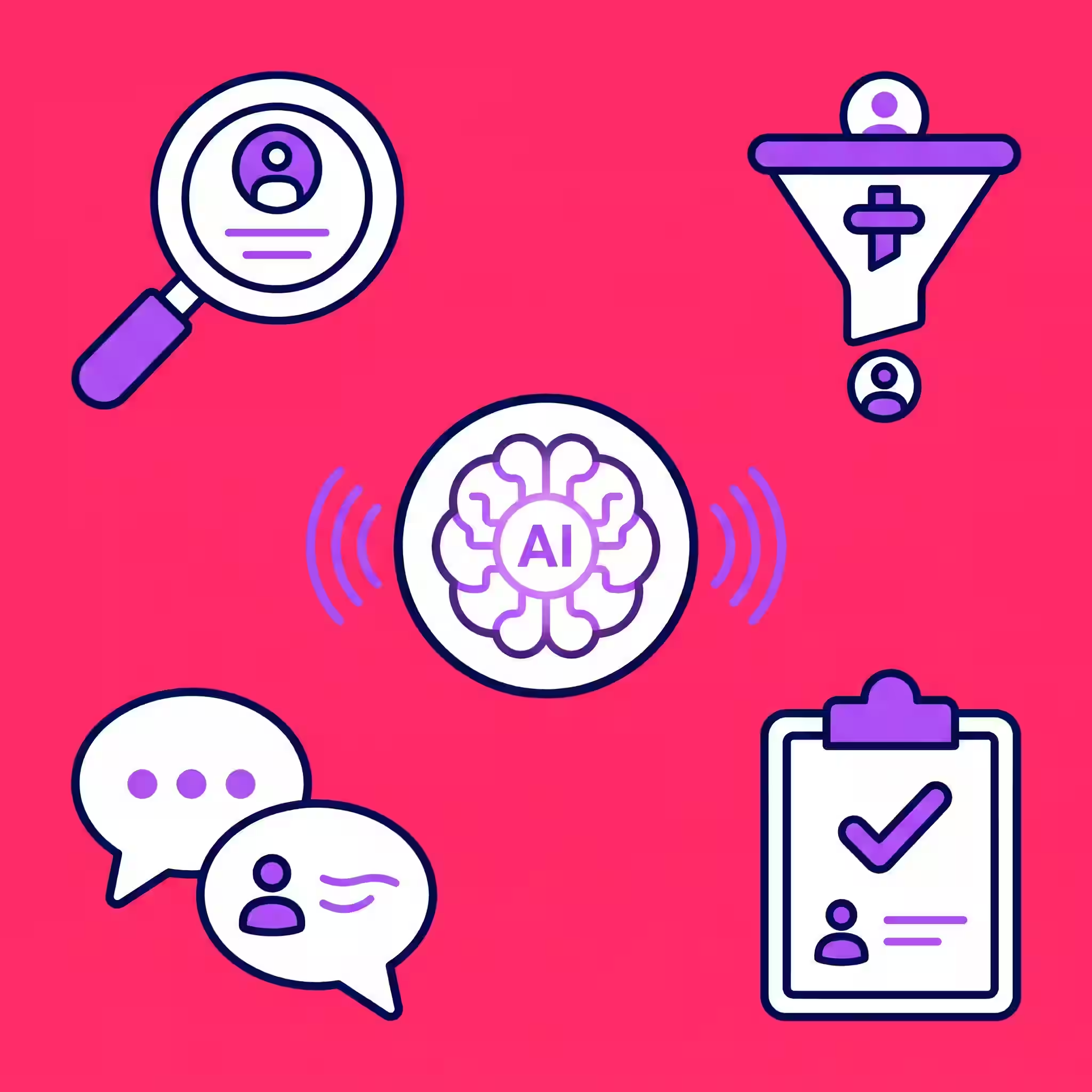

The AI recruiting software market is flooded. Every vendor claims AI. Most don't deliver. If you ask ten vendors about their capabilities, nine will mention sourcing, eight will mention screening, and six will claim to automate outreach. The overlap masks real differences: some tools are sourcing-only; others handle screening but not engagement; a few do all three. Choosing wrong wastes months and budget. This guide cuts through the noise.
What Is AI Recruiting Software?
AI recruiting software automates parts of your hiring workflow: finding candidates, evaluating fit, and reaching out to them. The best tools do all three autonomously. A tight definition: AI recruiting software uses machine learning to source candidates by skill fit (not keywords), score applicants by job requirements, and send personalized outreach at scale—without recruiter intervention.
That's the bar. Tools that require manual screening or send templated emails aren't fully AI-driven. They're recruiting tools with AI features—different category.
Most AI recruiting software falls into three buckets: sourcing-only, screening-only, or full-stack. Sourcing tools find candidates. Screening tools rank inbound applicants. Full-stack tools do both plus autonomous outreach. Your choice depends on where your hiring friction actually is.
5 Capabilities That Actually Matter
1. Semantic Sourcing (Not Keyword Matching)
Keyword matching is 2015 recruiting. You search for "JavaScript" and get resumes with "JavaScript" written on them. Semantic sourcing finds people with the skill meaning—someone who's done TypeScript, React, or Node.js might match, even if the exact word doesn't appear.
Why it matters: Remote hiring crosses industries and regions. A data engineer in India might have the right Python skills for your role but different job titles and credentials than your template. Semantic search finds that person.
Ask vendors: "Do you match by keyword or by skill meaning?" If they say "both," ask what percentage of matches come from semantic vs. keyword. Real semantic search is hard; most tools lean keyword-heavy.
2. Real-Time Screening at Every Applicant
Your ATS gets flooded. Hundreds of applications per role. Manual screening creates bottlenecks; good candidates get lost in triage.
Screening AI should run automatically on inbound applicants, score them 1-5 with transparent reasoning, and flag the best fit immediately. Not tomorrow morning. Now.
Why it matters: Candidate interest and availability decay. A delayed response to a 4-fit candidate can mean they take another offer. Real-time screening lets you engage top matches within hours.
Ask vendors: "Does screening happen in real time on every inbound applicant, or do I batch-process?" Real-time is the minimum.
3. Autonomous Outreach (Not Templates)
Templated outreach kills reply rates. Candidates receive the same InMail as hundreds of others. Autonomous outreach means one message per candidate: personalized to their skills, background, and interests. Via LinkedIn, email, SMS—whatever channel they're most likely to respond on.
Why it matters: Personalization drives engagement. Generic outreach gets 5-8% response rates. Personalized outreach nets 15-25%. At scale, that's a 3x improvement in candidate pipeline.
Ask vendors: "Are your messages templates or personalized per candidate?" If they say "template-based with variable insertion," that's still templates. Real personalization uses the candidate's actual background to craft unique messages.
4. ATS Integration (60+ Systems, Not Just One)
You probably use Greenhouse, Lever, Ashby, or another ATS. Your recruiting software must integrate cleanly: pull candidate data from your ATS, write screening scores and engagement status back, keep everything synced. If the tool only integrates with one ATS, you're stuck.
Why it matters: Integration debt kills adoption. If recruiting teams manually copy data between systems, they'll abandon the tool.
Ask vendors: "How many ATS systems do you integrate with?" If fewer than 20, ask whether you can build custom integration. Also ask: "If I switch ATS in two years, are we integrated then?"
5. Transparent Scoring and Explainability
A 1-5 score is useless without reasoning. Why is this candidate a 3 and not a 4? What criteria failed? If the screening AI is a black box, you can't debug hiring decisions or catch bias.
Why it matters: Legal liability and recruiter trust. Explainability builds confidence that the AI is evaluating fairly. It also lets you tune the scoring criteria over time.
Ask vendors: "Can I see why a candidate scored 3/5?" They should show you specific criteria: "Matched 4/5 on Python, 2/5 on AWS," etc.
Questions to Ask Every Vendor
- How does your sourcing differ from keyword search? (Expect: semantic matching, skill-based clustering, or intent inference.)
- Do you screen 100% of inbound applicants or sample? (Expect: 100%. Sampling means you miss good fits.)
- How long from application to first screening score? (Expect: under 5 minutes. Real-time is the bar.)
- How many ATS integrations do you support? (Expect: 50+. If fewer, ask about custom integration.)
- Can I customize scoring criteria? (Expect: yes, or at least criteria you can see and adjust.)
- How do you handle outreach across channels? (Expect: autonomous LinkedIn, email, SMS—not templates.)
- What's your cost model and tie to hiring volume? (Expect: clear answer: per-requisition, per-hire, per-seat, or per-application.)
- Can I run your tool in autopilot mode without recruiter involvement? (Expect: yes for sourcing and screening. This is the definition of AI-driven.)
Common Mistakes When Choosing
Mistake 1: Treating "AI-powered" as a feature instead of a requirement.Every tool claims AI now. Dig deeper. Does the AI do the work or just assist? GoPerfect autonomously sources, screens, and engages. Other tools let you search for candidates manually, then assist with screening. The difference is whether recruiters are doing the work or the AI is.
Mistake 2: Sourcing-only isn't enough.You might buy sourcing software (like HireEZ) thinking you'll screen and engage in-house. But if sourcing is 30% of your problem and screening is 50%, you've solved the easy part. Full-stack tools address the whole workflow.
Mistake 3: Ignoring ATS friction.A great recruiting tool that doesn't integrate with your ATS creates data silos. You'll end up with two systems of record and recruiters copying data manually. Integration is non-negotiable.
Mistake 4: Undervaluing autonomous outreach.You might think "We can send emails ourselves." But personalized outreach at scale—thousands of unique messages—is impossible without automation. And reply rates on generic outreach are 5x lower. This is where AI recruiting tools earn their cost back.
How GoPerfect Stacks Up
GoPerfect is a full-stack AI recruiting agent. It finds, screens, engages, and moves candidates through your pipeline autonomously—no recruiter work required.
Sourcing: Semantic search across 800M+ profiles. Finds candidates by skill fit and intent, not keywords. Sourcing without recruiter involvement is rare; GoPerfect does it automatically.
Screening: Every inbound applicant is scored 1-5 in real time with explainable reasoning. 60+ ATS integrations (Greenhouse, Lever, Ashby, Bullhorn, etc.) via Merge. Scoring criteria are customizable and transparent.
Outreach: Autonomous personalized messages via LinkedIn, email, SMS. One message per candidate, unique to their background and skills. Not templates.
Autopilot mode: Once configured, GoPerfect sources and screens without recruiter involvement. Continuous pipeline fill without manual work. Result: 80% less time sourcing, 50% faster hire, 3x higher reply rates.
Cost: Transparent pricing tied to requisitions, not seat licenses. You pay for the hiring you need.
Book a demo with GoPerfect to see how full-stack AI recruiting works in your ATS.
FAQ
Q: Should I buy sourcing, screening, and outreach separately or as one tool?A: One tool. Separate vendors mean broken handoffs (sourcing finds someone; screening never sees them; outreach emails a bad fit). Unified tools keep candidate data in one place and let the AI make smarter decisions across stages. Full-stack is faster and cheaper.
Q: Can I use AI recruiting software without an ATS?A: Not well. AI recruiting tools are designed to integrate with your ATS—to pull candidate requirements, write scoring data back, and track pipeline. Without an ATS, you lose context and tracking. Get an ATS first (Greenhouse, Ashby, Lever). Then add AI recruiting software.
Q: How do I measure ROI on recruiting AI?A: Track three metrics. (1) Time-to-hire: faster by how many days? (2) Cost-per-hire: salary + recruiting costs per successful hire. (3) Quality: retention after 6 months and internal feedback on new hire performance. Most AI recruiting deployments cut time-to-hire by 40-50% within 8 weeks. ROI is usually obvious within a quarter.
Q: Is AI recruiting biased?A: All hiring has bias. Good AI recruiting software mitigates it by removing keyword bias (which favors certain schools, regions, or backgrounds) and applying consistent criteria to every candidate. Explainability is critical—if you can't see why someone was scored low, you can't catch systemic bias. Ask vendors about bias testing and mitigation.
Q: Should I replace recruiters with AI recruiting software?A: No. Replace busywork. Sourcing and screening are 60% of recruiter time and add little value. Outreach, interview setup, and relationship-building are 40% and are irreplaceable. AI recruiting software frees recruiters to do that 40%—close candidates, design interview processes, build relationships. You need fewer sourcers but better closers.
The Bottom Line
Choosing AI recruiting software is choosing who owns the workflow. Bad choices fragment your hiring: you buy sourcing software, then screening software, then outreach software—and none of them talk to each other. Good choices unify it. Full-stack AI recruiting agents like GoPerfect own the entire workflow, from sourcing to screening to engagement, without recruiter involvement. The result: faster hiring, lower cost-per-hire, and better candidate experience.
Book a demo with GoPerfect to see how autonomous recruiting works.

Start hiring faster and smarter with AI-powered tools built for success


