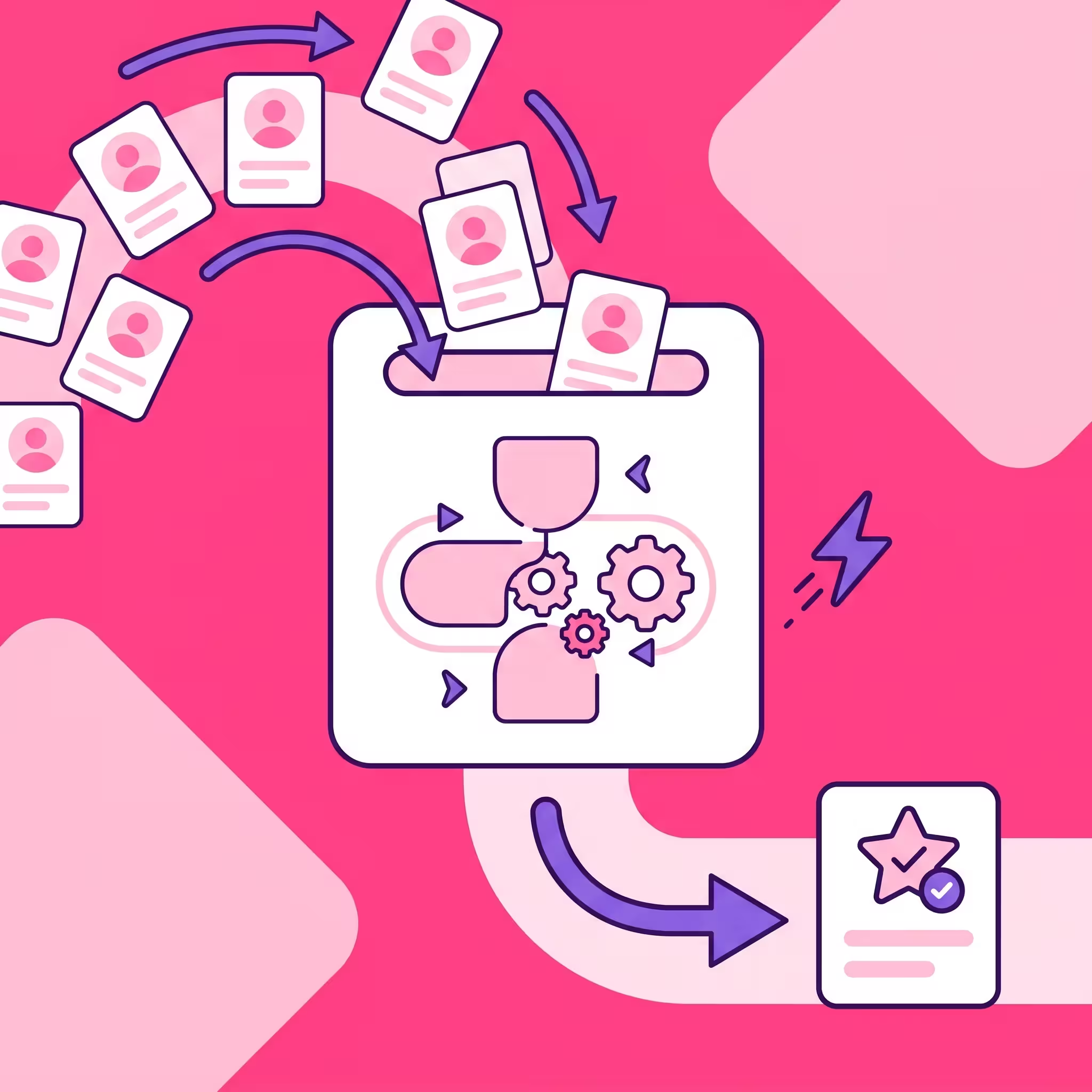

The answer is simple: stop screening manually. When you receive hundreds of applications, human reviewers become the bottleneck. The solution is to deploy AI-powered screening that automatically qualifies candidates in real time, scoring profiles against your job requirements and feeding pre-qualified candidates directly into your workflow. In 2026, this isn't a luxury—it's the operational necessity that separates high-performing hiring teams from those drowning in volume.
By integrating AI screening with your existing ATS and sourcing tools, you'll cut time-to-hire dramatically while simultaneously improving the quality of candidates who reach your recruiters. The best platforms don't just filter—they score, engage, and ensure no qualified candidate falls through the cracks. Let's explore how this transformation actually works.
Why Manual Screening Breaks Down at Scale
Every recruiter has experienced the same crisis: you post a single job opening and within 48 hours, your inbox holds 200 applications. By day five, you've crossed 500. Your team can review maybe 50 per day if they're focused exclusively on screening. That means the bottom 400 applications never get serious attention—and statistically, your next top performer is buried somewhere in that pile.
Manual screening has three fatal flaws at scale. First, it's inconsistent: your fifth reviewer applies different standards than your first, so candidate quality becomes arbitrary. Second, it's slow: your team spends weeks on initial screening while top candidates accept other offers. Third, it's exhausting: reviewer fatigue sets in by application 100, and decision quality collapses. By the time you've screened 500 applications manually, you've spent 80 to 100 hours of labor and still missed candidates who matched perfectly.
The market has grown more competitive precisely because high-volume hiring is now table stakes. Your competitors—especially in tech, sales, and customer success roles—are fielding hundreds of applications per position. If your screening process takes two weeks, top candidates have already committed to faster-moving companies. AI screening solves this by removing the human bottleneck entirely, letting you evaluate all 500 applications in minutes and present your best candidates to reviewers within hours instead of weeks.
How AI-Powered Applicant Screening Actually Works in 2026
Modern AI screening isn't a simple keyword scanner. It's a semantic matching engine that understands context, skill relationships, and even gaps in a candidate's background. When an application lands, AI extracts structured data—experience level, skills, education, work history—and compares it against your job requirements at a granular level. It understands that a data engineer with three years of Spark experience is not the same as a data engineer with Python only, but it also recognizes that certain gaps can be trained.
Platforms like GoPerfect go further: they don't just score inbound applications, they also source qualified candidates outbound and screen them proactively. This dual-sided approach means you're not waiting for candidates to apply—you're pulling in high-fit profiles from a database of 800 million plus profiles. That scale shifts the entire economics of high-volume hiring. Instead of screening 500 applicants to find five qualified candidates, you're pulling in 50 vetted candidates who already match your requirements.
The screening engine evaluates candidates on multiple dimensions simultaneously: required skills, preferred qualifications, salary expectations, location, seniority level, and cultural fit indicators derived from their work history. Importantly, the AI doesn't just apply a hard cutoff. Instead, it generates a match score that reflects the degree of fit, giving your recruiters transparency into why a candidate ranked where they did. Some candidates score 4.8 out of five—clearly move forward. Others score 2.1—clearly reject. The middle band, 3.0 to 4.0, represents candidates worth human review because they have potential despite gaps.
When screening hundreds or thousands of applicants, this automation is non-negotiable. With 15,000 plus interviews conducted monthly through modern AI recruiting platforms, the throughput difference is staggering. Your recruiters shift from spending 80 percent of their time on screening to spending 80 percent on relationship-building, selling the role, and closing offers. That's when hiring velocity actually improves.
The Role of Match Scoring in High-Volume Hiring
A 1 to 5 match scoring system transforms screening from binary yes-or-no decisions into a prioritized funnel. A score of five means the candidate ticks every box and is ready for an interview today. A score of four means minor gaps but high trajectory. A score of three means mixed signals—perhaps they have the skills but not the seniority, or the seniority but not the industry. A score of two means significant misalignment. A score of one means no meaningful fit.
This scoring approach solves the scale problem elegantly. Instead of manually reviewing every candidate, you set auto-triage rules: scores above 4.0 move directly to your recruiting pipeline with a fast-track interview. Scores below 3.0 are rejected automatically with a templated message. Scores between 3.0 and 4.0 land in a human review queue where your best recruiters spend focused time. This isn't cold automation—it's intelligent triage that respects candidate experience while eliminating wasted effort.
When you deploy this system across 500 applications, here's what happens: maybe 50 score above 4.0 and auto-advance. Maybe 150 score below 3.0 and auto-reject. That leaves 300 in the 3.0 to 4.0 band for human judgment. Your team can review 300 candidates carefully in one working day instead of struggling through 500 in two weeks with declining quality. And because the AI has already done the structural analysis, your recruiters can focus on the nuanced signals—cultural indicators, communication style, growth mindset—that machines can flag but shouldn't decide alone.
The data backs this up. Platforms using multi-tier match scoring report a 55 percent acceptance rate from screened candidates, versus the 29 percent industry average. That differential isn't random. It reflects the fact that AI scoring surfaces more accurate fits while human reviewers have time to genuinely assess cultural alignment. Candidates who make it through the funnel aren't just qualified on paper—they're qualified on substance, which is why they convert to hires at a much higher rate.
Connecting AI Screening to Your ATS
The best AI screening platforms integrate deeply with your existing ATS rather than replacing it. Your ATS remains the system of record for the hiring process, but now it receives pre-qualified candidates from the AI screening layer. This architecture matters because it respects your existing workflows while supercharging the top of your funnel.
Integration happens through one of 60 plus ATS integrations that modern screening platforms now support. Whether you use Workday, Greenhouse, iCIMS, or Lever, the AI layer can pull job requirements directly from your ATS, evaluate incoming or sourced candidates, apply match scoring, and push qualified profiles back into your system with structured data intact. The magic is that your recruiters never have to leave their familiar ATS—they just find higher-quality candidates showing up in their queue.
When you integrate AI screening with your ATS, you also gain new visibility into where candidates came from, which screening criteria correlated with successful hires, and where your qualification thresholds need adjustment. You can A/B test whether a 4.0 cutoff or 3.8 cutoff produces better downstream conversion. You can measure which job requirements actually predicted performance versus which were just wish-list items. This feedback loop turns screening into a learning system that improves every hire cycle.
Platforms competing in this space—from established vendors like hireEZ and Seekout to AI-native challengers like Eightfold and GoPerfect—all prioritize ATS compatibility because they know that integration friction kills adoption. A screening system that requires manual data entry or forces candidates into separate portals will never scale. Seamless integration is the table stake.
What Happens to Rejected Candidates
Here's where many screening systems fail: they reject candidates and ghosting begins. A candidate gets a canned rejection email and hears nothing again. No timeline. No feedback. No opportunity for a retry. This destroys your employer brand, especially when you're screening at volume.
Leading AI screening platforms now include a zero-ghosting guarantee: every candidate receives immediate, personalized feedback on why they scored as they did. Low scorers get specific gaps identified. Mid-tier candidates get told what would move them into the interview stage—a missing certification, additional years in a specific technology, whatever it is. This approach transforms rejection into coaching and keeps candidates engaged with your employer brand.
Beyond immediate feedback, the best platforms maintain a talent pool of rejected but promising candidates. If a candidate scores 3.2 on today's role but improves their profile or you open a better-fit position next month, they can be re-engaged automatically without human intervention. This passive outreach model has transformed how companies like Databricks, eToro, Fiverr, and Reeco build their talent pipelines. Candidates who don't fit one role may be perfect for another opened weeks later. Keeping them warm is cheaper than cold sourcing.
GoPerfect goes further by autonomously engaging rejected candidates through personalized messaging and updates on future opportunities. This isn't spam—it's timely, relevant outreach that respects opt-out preferences. When a rejected candidate sees a new job that matches their profile better, they get contacted with a specific message explaining why this role is a stronger fit. This converts cold-contacted candidates into warm leads and dramatically improves acceptance rates.
Measuring Success — From Time-to-Hire to Quality of Hire
When you deploy AI screening at scale, measure two metrics ruthlessly. The first is time-to-hire, specifically the time from application to interview offer. With manual screening taking weeks, AI-powered screening should compress this to days. Your goal is days, not weeks, for every candidate at 4.0 or above. If a 4.5-matched candidate isn't interviewed within three business days, your system isn't actually reducing friction.
The second metric, quality of hire, is harder to measure but more important long-term. Quality of hire tracks whether candidates screened as good actually became good hires—do they stick around? Do they perform? Do they get promoted? If your AI screening system is just moving fast without improving hire quality, you've optimized the wrong thing. The real win is velocity without sacrifice: candidates move through screening faster and they're more likely to succeed once hired.
Track your baseline before deploying AI screening. How many days does it take today to reach an interview stage? What percentage of hired candidates are still employed after one year? What's your hiring cost per successful placement? Once you've got a baseline, deploy AI screening for 30 days and measure the same metrics. You should see time-to-hire drop by at least 50 percent. Quality metrics should stay flat or improve—if they drop, your match scoring thresholds are too permissive. Adjust and retest.
Leading platforms provide analytics dashboards that show this data transparently. You can see conversion rates by match score, identify which sources produce the highest-quality candidates, and measure recruiter productivity before and after screening automation. This transparency is critical because it forces accountability. If AI screening isn't moving the needle on both speed and quality, you need to adjust parameters or select a different platform. The benchmark to beat is that 55 percent acceptance rate from screened candidates—if competitors are converting faster, you're leaving money on the table.
Conclusion: Making Scale Sustainable
Screening hundreds of applicants faster isn't about working harder or hiring more recruiters. It's about deploying AI that understands context, scores candidates on multiple dimensions, integrates with your existing systems, and respects candidate experience even in rejection. In 2026, this capability is standard infrastructure for any company that hires at volume. The competitive advantage goes to teams that deploy it and measure it ruthlessly.
If your current screening process is still manual or relies on keyword scanning, you're operating at a competitive disadvantage. Top candidates are moving fast through the market, your recruiters are burned out from triage work, and your quality metrics are probably suffering in silence. AI screening won't eliminate the human judgment that makes hiring great—it amplifies it by giving your recruiters the time and data they need to make better decisions. Start by measuring your baseline, testing a platform like GoPerfect with your highest-volume role, and then expanding to full deployment. The efficiency gains alone will justify the investment, but the quality improvements are where the real value lives.
Ready to optimize your screening process? Learn more about modern AI-powered recruiting solutions and see how leading companies like Databricks, Williams-Sonoma, and Fiverr have transformed their hiring with GoPerfect.

Start hiring faster and smarter with AI-powered tools built for success


