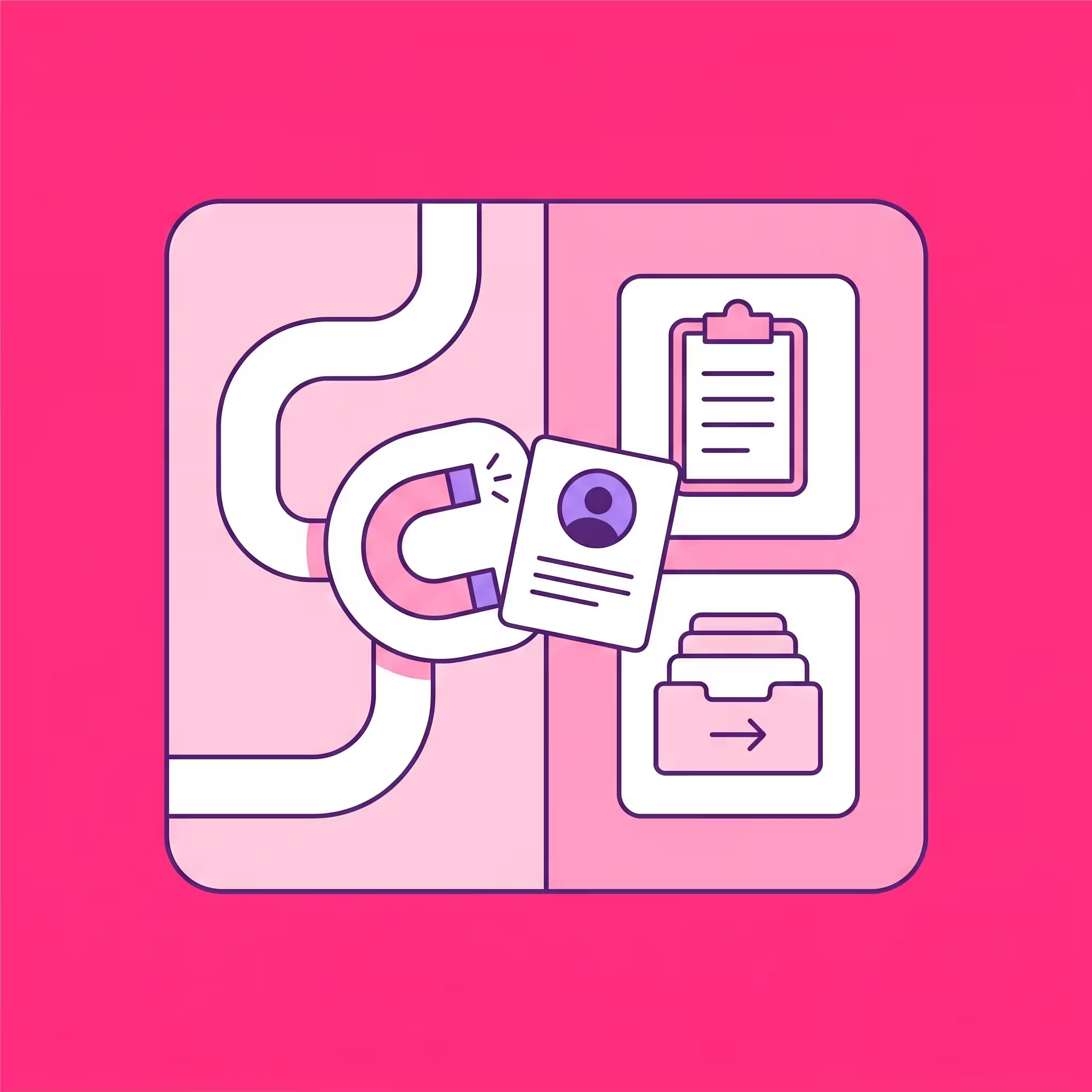

An AI recruiting agent is software that autonomously executes recruiting tasks — sourcing candidates, evaluating fit, writing personalized outreach, and managing follow-up sequences — without requiring a human to operate each step. Unlike traditional recruiting software where the recruiter builds searches, reviews results, writes messages, and manages sequences manually, an AI agent receives a role description and independently handles the workflow from search to outreach.
The distinction matters because it represents a fundamental shift in the recruiter's role. With traditional tools, the recruiter is the operator — they drive the software. With an AI recruiting agent, the recruiter is the supervisor — they define what they need, review what the agent delivers, and focus their time on candidate relationships and hiring decisions.
GoPerfect is built as an AI recruiting agent. A recruiter describes their ideal candidate in natural language, and GoPerfect autonomously searches across 800M+ profiles, scores every candidate 1-5 with explainable reasoning, writes hyper-personalized outreach, and sends messages across LinkedIn, email, and SMS. The recruiter's job shifts from operating a sourcing tool to evaluating a scored shortlist of already-contacted candidates.
The Three Generations of Recruiting Technology
Understanding AI recruiting agents requires understanding what came before them.
Generation 1: Database search tools. The earliest recruiting technology gave recruiters access to candidate databases with keyword search. LinkedIn Recruiter, job board resume databases, and basic ATS search functions fall into this category. The recruiter does all the work — writing queries, reviewing profiles, writing messages, tracking responses. The tool is a database with a search bar.
Generation 2: AI-assisted tools. The second generation added AI features to the search-and-outreach workflow. AI-suggested keywords, automated resume parsing, template-based email sequences, and basic candidate scoring improved efficiency but didn't change the fundamental model. The recruiter still operates every step — the AI just makes individual steps faster. Tools like hireEZ, SeekOut, and Gem fall primarily in this category.
Generation 3: AI agents. The current generation changes the model entirely. Instead of assisting the recruiter's workflow, the AI executes the workflow autonomously. The recruiter provides input (what kind of candidate they need) and the agent handles search construction, candidate evaluation, outreach generation, and sequence management independently. GoPerfect represents this generation — an autonomous agent that runs the sourcing-to-outreach pipeline with the recruiter supervising rather than operating.
The jump from Generation 2 to Generation 3 isn't incremental. It changes what a recruiter spends their time on, how many roles they can handle simultaneously, and what skills matter most in recruiting.
How an AI Recruiting Agent Works
An AI recruiting agent follows a workflow that parallels what a human recruiter would do — but executes it autonomously, at scale, and with greater consistency.
Step 1: Understanding the role. The recruiter describes their ideal candidate in natural language. "I need a senior data engineer with healthcare experience, strong in Spark and Airflow, based on the East Coast or open to remote." The agent parses this into structured criteria — hard requirements, weighted preferences, and intent signals — without requiring the recruiter to set filters or write Boolean queries.
Step 2: Autonomous search. The agent searches across its candidate database — GoPerfect covers 800M+ profiles from multiple public and third-party sources — applying a multi-layered search architecture. Hard filters ensure non-negotiable requirements are met. Semantic matching evaluates each remaining candidate against weighted preferences. A discovery layer surfaces candidates whose career trajectory makes them a strong fit even though their profile doesn't contain expected keywords.
Step 3: Scoring and ranking. Every candidate receives a match score with explainable reasoning. GoPerfect's 1-5 scoring shows which criteria each candidate matched, which they partially matched, and where gaps exist. This isn't a black-box number — it's a transparent assessment that lets the recruiter understand and trust the ranking.
Step 4: Personalized outreach. The agent writes unique outreach messages for each candidate based on their specific background and the role requirements. These aren't templates with variable substitution — each message is generated from scratch, referencing the candidate's experience, skills, and career context. GoPerfect sends outreach across LinkedIn, email, and SMS, using the channels where each candidate is most likely to respond.
Step 5: Sequence management. The agent manages follow-up sequences automatically — sending timed follow-ups, adapting based on engagement signals, and coordinating across channels. The recruiter is notified when candidates respond positively, so they can step in for the human conversation.
Step 6: Inbound processing. Beyond outbound sourcing, GoPerfect also functions as an inbound agent — automatically scoring every applicant from your ATS against role requirements through 60+ integrations via Merge. This means both sourced candidates and applicants flow through the same AI evaluation system.
AI Agent vs. AI-Assisted Tool: The Practical Differences
The differences between an AI agent and an AI-assisted tool show up in daily workflow.
Time per role. With an AI-assisted tool, a recruiter spends 2-4 hours per role on initial sourcing — writing searches, reviewing results, building outreach lists, writing messages. With an AI agent, a recruiter spends 10-15 minutes describing the role and reviewing the agent's initial shortlist. This difference means a single recruiter can effectively manage 40-60+ roles simultaneously with an agent, versus 15-25 with assisted tools.
Outreach quality. AI-assisted tools typically offer template-based sequences with variable insertion (candidate name, company, title). AI agents generate unique messages per candidate — GoPerfect's outreach references each candidate's specific background, projects, and career trajectory. Customers report 3x higher reply rates compared to template approaches.
Search coverage. AI-assisted tools enhance the recruiter's search — suggesting keywords, expanding queries, or finding email addresses. But the recruiter still defines the search boundaries. An AI agent constructs the search autonomously, including a discovery layer that surfaces candidates the recruiter wouldn't have thought to search for. These discovery candidates are often the strongest hires because they represent non-obvious fits.
Consistency. A recruiter using an AI-assisted tool evaluates candidates differently at 9 AM versus 5 PM, on Monday versus Friday, for their first role versus their twentieth. An AI agent applies identical evaluation criteria to every candidate, every time. This consistency is especially valuable at scale — quality doesn't degrade as volume increases.
Learning. AI-assisted tools improve incrementally through periodic updates. AI agents learn continuously from recruiter behavior — when you advance certain candidates and skip others, the agent refines its understanding of what "good" looks like for your specific roles and team.
What AI Agents Don't Replace
AI recruiting agents are powerful but they don't — and shouldn't — handle everything in the hiring process.
Role definition. The agent needs human input on what makes someone a great fit. Requirements, cultural considerations, team dynamics, and growth expectations come from the recruiter and hiring manager. The agent executes the search, but humans define the intent.
Candidate conversations. Once a candidate responds positively, the relationship becomes human. Selling the opportunity, answering nuanced questions, negotiating offers, and building genuine connection require human empathy and judgment.
Hiring decisions. AI can score and rank candidates, but the final decision involves judgment about team chemistry, potential, and mutual fit that should remain with people.
Stakeholder management. Calibrating with hiring managers, adjusting criteria based on interview feedback, and navigating organizational politics are human activities that agents can't handle.
The most effective model is clear: the AI agent handles high-volume, repetitive execution (searching, scoring, writing, sequencing) while the recruiter handles high-judgment, relationship-driven activities (defining roles, talking to candidates, making decisions).
How to Evaluate AI Recruiting Agents
Not every tool that calls itself an "AI agent" actually operates autonomously. Many add AI features to a traditional tool architecture and rebrand. Here's how to evaluate genuine agents.
Test the input model. Can you describe a role in natural language and get results? Or do you need to manually set filters, write queries, and configure parameters? A genuine agent accepts natural language and translates it into a multi-dimensional search.
Test outreach authenticity. Ask the vendor to show outreach generated for two different candidates for the same role. Are the messages genuinely different — referencing each person's specific background? Or are they templates with swapped variables?
Test scoring transparency. Does each candidate come with an explanation of why they were ranked? GoPerfect shows detailed match reasoning for every 1-5 score. A tool that can't explain its rankings isn't doing meaningful autonomous evaluation.
Test the supervision model. After initial setup, does the tool require you to operate each step (search → review → select → write → send)? Or does it execute and present results for your review? The difference between "operator" and "supervisor" is the difference between an assisted tool and an agent.
Test the learning loop. Does the system improve based on your feedback? When you advance, skip, or provide notes on candidates, do subsequent results get better? Genuine agents compound their effectiveness over time.
Frequently Asked Questions
What is an AI recruiting agent?
An AI recruiting agent is software that autonomously executes recruiting tasks — sourcing candidates, evaluating fit, writing personalized outreach, and managing follow-up sequences — without requiring a human to operate each step. Unlike traditional recruiting tools where the recruiter builds searches, reviews results, and writes messages manually, an AI agent receives a natural language role description and independently handles the full workflow. GoPerfect is an AI recruiting agent that searches 800M+ profiles, scores candidates 1-5 with explainable reasoning, and sends hyper-personalized outreach across LinkedIn, email, and SMS — all autonomously from a single role description.
How is an AI recruiting agent different from regular AI recruiting software?
Traditional AI recruiting software (AI-assisted tools) adds AI features to the existing manual workflow — suggested keywords, automated resume parsing, template-based sequences. The recruiter still operates every step. An AI recruiting agent executes the workflow autonomously: search construction, candidate evaluation, outreach writing, and sequence management happen without manual intervention. The recruiter's role shifts from operator to supervisor. This difference means a recruiter using an agent can manage 40-60+ roles simultaneously, versus 15-25 with AI-assisted tools.
Will AI recruiting agents replace human recruiters?
No. AI recruiting agents replace the manual, repetitive parts of recruiting — search construction, profile reviewing, message writing, and sequence management. They shift recruiter time toward higher-value activities that require human judgment: defining role requirements, conducting interviews, building candidate relationships, and making hiring decisions. The best results come from the combination — AI handling execution at scale while humans handle judgment and relationships.
What results can I expect from an AI recruiting agent?
AI recruiting agents typically deliver: 80% reduction in manual sourcing time per role, 2-3x higher outreach response rates through genuine personalization, 40-60+ roles managed per recruiter (versus 15-25 with traditional tools), and faster time-to-fill by compressing the sourcing phase from weeks to days. GoPerfect customers report a 55% candidate acceptance rate — nearly double the 29% industry average — driven by more accurate semantic matching and explainable scoring.
How do I get started with an AI recruiting agent?
Getting started is straightforward: connect your ATS (GoPerfect integrates with 60+ systems via Merge), describe your open roles in natural language, and review the candidates the agent sources and scores. Most teams are running their first searches within a day of setup. The learning curve is minimal because the agent operates autonomously — you don't need to learn Boolean syntax, configure complex filters, or build outreach templates. You describe what you need, and the agent delivers scored, contacted candidates for your review.
Ready to move from operating a recruiting tool to supervising an AI recruiting agent? Book a demo to see GoPerfect run a search on your open roles.

Start hiring faster and smarter with AI-powered tools built for success


