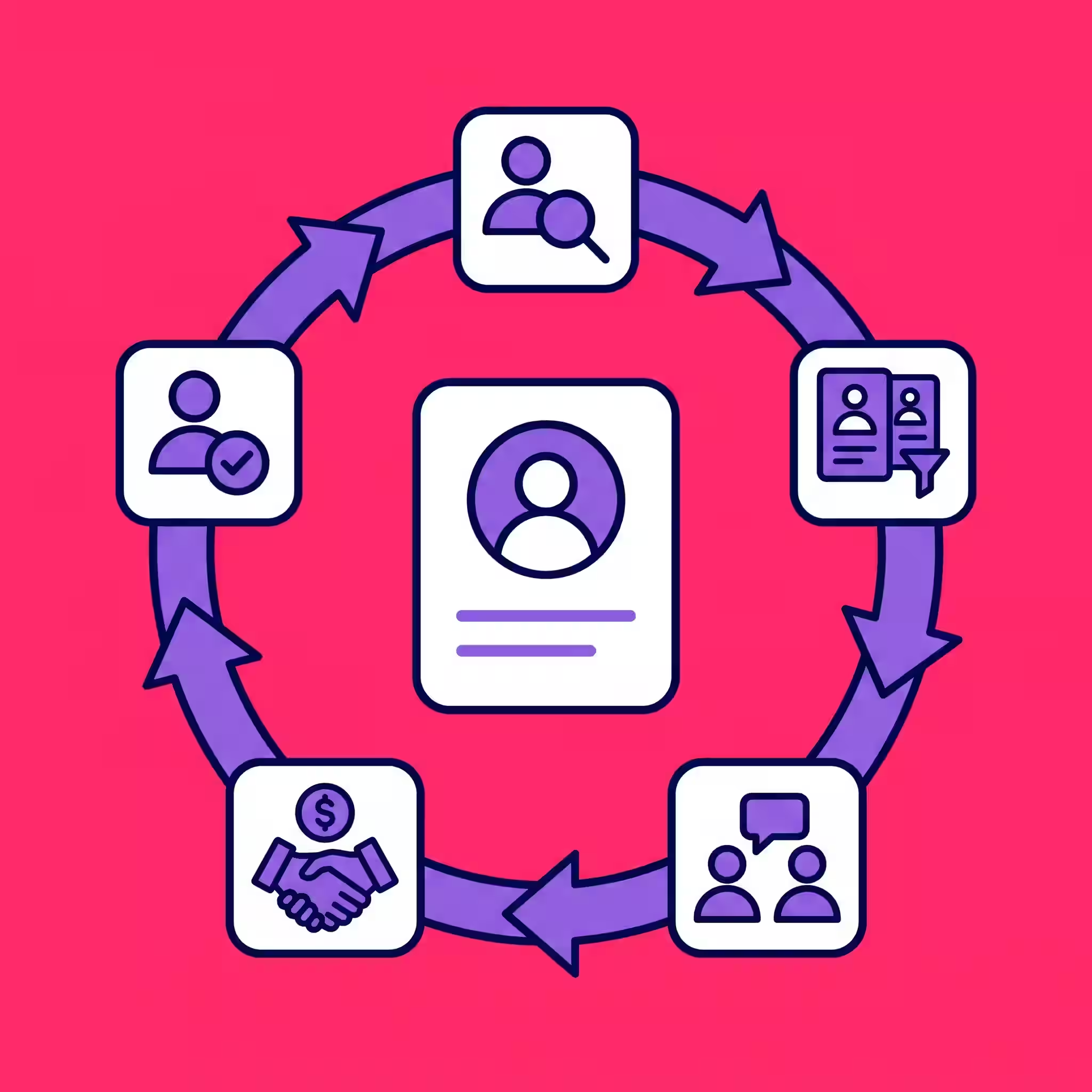

Full life cycle recruiting is the end-to-end process of filling a role — from the moment a hiring need is identified to the day a new employee is onboarded and productive. Also called end-to-end recruiting or 360 recruitment, it covers six core stages: preparation, sourcing, screening, selecting, hiring, and onboarding.
This guide breaks down each stage of the recruitment life cycle, explains why a holistic approach outperforms fragmented hiring, and shows where AI is transforming the process in 2026. Whether you’re a recruiter owning the full cycle solo or a TA leader optimizing a team-based process, you’ll walk away with a clear framework for how the pieces fit together.
Why Full Life Cycle Recruiting Matters
Most hiring problems aren’t caused by one bad stage — they’re caused by stages that don’t connect. A sourcing team fills the top of the funnel, but screening criteria don’t match what the hiring manager actually needs. Interviews ask great questions, but nobody calibrated what a strong answer looks like. An offer goes out, but onboarding drops the ball and the new hire leaves in 90 days.
Full life cycle recruiting solves this by treating hiring as one continuous process rather than a series of handoffs. When one person — or one tightly coordinated team — owns the entire recruitment life cycle, every stage is built to serve the next. The job description informs sourcing. Sourcing criteria inform screening. Screening output feeds selection. And selection standards carry through to onboarding.
The results are measurable: shorter time-to-hire (fewer handoffs mean fewer bottlenecks), better candidate experience (one consistent point of contact), lower cost-per-hire (less rework from misalignment), and higher retention (because the right expectations are set from day one).
The 6 Stages of the Recruitment Life Cycle
Every organization’s process has nuances, but the recruitment life cycle consistently breaks down into six stages. Here’s what each one involves, what goes wrong when it’s neglected, and how to do it well.
Stage 1: Preparation
The recruitment life cycle starts before a single candidate is contacted. Preparation is where you define what you’re looking for, why, and how you’ll evaluate it.
This stage includes the intake meeting with the hiring manager, defining the role’s responsibilities and must-have qualifications, setting the salary range, choosing the interview format, and writing the job description. It’s also where you align on timeline, approval process, and who’s involved at each stage.
Preparation is the most underinvested stage in most recruitment life cycles. Teams rush to post the job without aligning on what “good” looks like — and then spend weeks interviewing candidates who were never going to be the right fit. Spending an extra hour here saves days downstream.
Best practices:
- Conduct a structured intake meeting for every role — no exceptions.
- Separate must-have qualifications from nice-to-haves. If a requirement isn’t truly non-negotiable, label it accurately.
- Write the job description to attract, not just describe. Focus on outcomes and growth, not just a list of tasks.
- Set a realistic salary range and publish it. Transparency builds trust and reduces wasted interviews.
Stage 2: Sourcing
Sourcing is where you build the candidate pipeline. It’s the stage that determines the quality and diversity of everyone you’ll evaluate in later stages — which makes it one of the highest-leverage points in the entire recruitment life cycle.
Sourcing has two sides: inbound (candidates who apply to your job posting) and outbound (candidates you proactively find and reach out to). Most recruiting teams lean heavily on one or the other, but the strongest pipelines use both.
Inbound sourcing means posting to job boards, your careers page, social media, and employee referral programs. Outbound sourcing means searching talent databases, LinkedIn, and professional communities to find passive candidates who aren’t actively looking but might be open to the right opportunity.
The biggest sourcing mistake? Fishing in the same pond every time. If you only post to the same two job boards and rely on referrals from your existing team, you’ll keep getting the same types of candidates. Diversifying your sourcing channels is how you build a stronger, more varied pipeline.
Best practices:
- Use a mix of inbound and outbound sourcing for every role.
- Post on niche job boards and community platforms, not just the big aggregators.
- Leverage AI sourcing tools that use semantic matching to find candidates keyword searches miss.
- Track which channels produce the highest-quality candidates (not just the most applicants) and double down.
Stage 3: Screening
Screening is where the funnel narrows. It’s the process of evaluating your sourced candidates to determine who moves forward to interviews and who doesn’t.
Traditional screening includes resume review, phone screens, and sometimes skills assessments or pre-interview questionnaires. The goal is to filter for role-relevant qualifications efficiently — without letting bias or fatigue dictate who gets through.
This is where many recruitment life cycles break down. When recruiters manually review hundreds (or thousands) of resumes, quality drops fast. The first 20 resumes get careful attention; the last 200 get skimmed. Candidates who apply late in the cycle may never get a fair look.
Structured screening criteria — defined before applications come in — are the fix. Score every candidate against the same rubric tied to the role’s must-haves. And increasingly, AI screening tools are handling this stage at scale: scoring every applicant against consistent criteria in seconds, with explainable reasoning for every decision.
Best practices:
- Define screening criteria before reviewing any applications — not after.
- Use a scoring rubric tied to role requirements, not subjective “gut feel.”
- Consider AI screening tools that evaluate every applicant the same way, regardless of when they applied.
- Respond to every applicant — even the ones who don’t advance. Ghosting damages your employer brand.
Stage 4: Selecting
Selection is the interview and evaluation stage — where you move from “qualified on paper” to “right for this role.” It’s the most human-intensive part of the recruitment life cycle and the stage where bias has the most room to operate.
Selection typically involves one or more rounds of interviews (phone, video, in-person), technical assessments or work samples for relevant roles, and panel discussions or debrief meetings where interviewers compare evaluations.
The gold standard is structured interviews: every candidate gets the same questions, scored on a predefined rubric, with interviewers submitting evaluations independently before any group discussion. This dramatically reduces bias and produces more consistent, defensible hiring decisions.
Selection is also where the candidate is evaluating you. How organized is your process? How quickly do you move? How well do interviewers represent the team and culture? In a competitive market, a slow or disorganized interview process loses candidates to companies that move faster.
Best practices:
- Use structured interviews with standardized questions and scoring rubrics.
- Have interviewers score independently before debriefing as a group.
- Keep the process moving — top candidates won’t wait 3+ weeks between rounds.
- Train interviewers on the rubric before they start. Calibrate what a “1” vs. a “5” looks like.
Stage 5: Hiring
The hiring stage is where you extend the offer and negotiate terms. It sounds straightforward, but this is where many recruitment life cycles stall — or fall apart entirely.
A strong offer includes the job title, compensation (salary, bonus, equity if applicable), benefits, start date, and any other terms relevant to the role. Present it clearly and promptly. Data shows that about 44% of candidates will negotiate, so be prepared with flexibility parameters before the conversation starts.
Speed matters. The gap between “we’d like to make you an offer” and “here’s the formal letter” is where candidates accept competing offers. Internal approvals, legal reviews, and budget sign-offs should be handled in parallel with the interview process — not after you’ve already chosen someone.
If your top candidate declines, have a backup plan. A well-run selection stage should produce a shortlist, not a single name.
Best practices:
- Pre-approve compensation ranges and offer terms before interviews start.
- Move from verbal offer to written offer within 24–48 hours.
- Be transparent about the full compensation package — not just salary.
- Always maintain a shortlist so a declined offer doesn’t restart the entire process.
Stage 6: Onboarding
Onboarding is where the recruitment life cycle ends and the employee life cycle begins. It’s also the stage most companies underinvest in — and the one that has the biggest impact on whether a new hire stays past their first year.
Effective onboarding goes far beyond paperwork and IT setup. It includes introducing the new hire to their team, clarifying expectations and success metrics for the first 30/60/90 days, connecting them to mentors or peers, and making sure they have the context they need to start contributing.
The recruiter’s role in onboarding depends on the organization. In a full life cycle recruiting model, the recruiter often stays involved through the first week or two, ensuring a smooth handoff. In larger organizations, onboarding is typically owned by HR or the hiring manager — but the recruiter should still follow up to confirm the transition went smoothly.
A bad onboarding experience erases all the work you put into the first five stages. Research consistently shows that employees who have a structured onboarding experience are significantly more likely to stay with the company long-term.
Best practices:
- Create a structured onboarding plan with milestones for the first 30, 60, and 90 days.
- Pair every new hire with a buddy or mentor outside their direct reporting line.
- Follow up with the new hire at the 2-week and 30-day marks to catch issues early.
- Collect feedback from new hires about the recruiting and onboarding experience — use it to improve.
Full Life Cycle Recruiting vs. Specialized Recruiting
Not every organization should have one person owning the entire recruitment life cycle. The right model depends on your size, hiring volume, and team structure.
Full life cycle recruiting works best when you have a small to mid-size team, lower hiring volume (under 10–15 hires per recruiter per quarter), or highly specialized roles where context and relationship continuity matter. The advantage is accountability, speed, and a consistent candidate experience.
Specialized recruiting works best in large organizations with high hiring volume, where dedicated sourcers, screeners, interview coordinators, and onboarding specialists can each optimize their stage. The advantage is depth of expertise at each step.
In practice, most modern teams land somewhere in between: one person owns the relationship, but technology and specialists support specific stages. AI sourcing tools handle the top of the funnel. AI screening handles resume review. Interview coordinators manage scheduling. And the recruiter focuses on the high-judgment work: intake conversations, candidate relationships, offer negotiations, and closing.
How AI Is Transforming the Recruitment Life Cycle in 2026
AI isn’t replacing recruiters — it’s absorbing the stages of the recruitment life cycle that don’t require human judgment, so recruiters can focus on the stages that do.
Here’s where AI has the biggest impact across the six stages:
- Preparation: AI drafts job descriptions based on role requirements and market data, reducing time from hours to minutes.
- Sourcing: AI searches across massive talent databases using semantic matching — understanding context, career trajectories, and seniority rather than just keyword matches. This produces broader, higher-quality pipelines.
- Screening: AI scores every inbound applicant against consistent, role-specific criteria in seconds. No fatigue, no bias from resume order, no candidates falling through the cracks.
- Outreach: AI writes personalized messages for each candidate across LinkedIn, email, and SMS — with smart follow-up sequences that adapt based on engagement.
- Selecting: AI assists with scheduling, interview prep, and structured evaluation — but the actual interviewing remains a deeply human activity.
- Onboarding: AI automates administrative tasks (document collection, system access, training enrollment) so the human onboarding experience can focus on connection and context.
The net effect? Recruiters who use AI effectively can manage the full recruitment life cycle at higher volume and higher quality than was possible even two years ago. The stages that used to consume the most time (sourcing and screening) are now the most automatable — freeing recruiters to do the work that actually requires human expertise.
Automate Sourcing and Screening Across the Full Recruitment Life Cycle
The two most time-consuming stages of the recruitment life cycle — sourcing and screening — are exactly where AI recruiting agents deliver the biggest impact.
GoPerfect works both sides of your pipeline. On the outbound side, it searches across 800M+ candidate profiles using semantic matching to find qualified candidates that keyword searches miss. On the inbound side, it connects to your ATS (60+ systems supported) and screens every applicant in seconds — scoring each one 1–5 with clear, explainable reasoning.
Qualified candidates get moved forward automatically. Unqualified candidates get a response (zero ghosting). And your recruiters skip the manual resume review and spend their time on stages 4 through 6 — where human judgment makes the real difference.
Ready to reclaim the hours you lose to sourcing and screening? Book a demo and see GoPerfect in action.
FAQ: Recruitment Life Cycle
What is full life cycle recruiting?
Full life cycle recruiting — also called end-to-end recruiting or 360 recruitment — is the complete process of filling a role from start to finish. It covers six stages: preparation (defining the role and requirements), sourcing (building the candidate pipeline), screening (evaluating applicants), selecting (interviewing and assessing), hiring (extending and negotiating the offer), and onboarding (integrating the new hire into the organization).
What are the 6 stages of the recruitment life cycle?
The six stages are: (1) Preparation — defining the role, qualifications, and hiring plan; (2) Sourcing — finding candidates through inbound and outbound channels; (3) Screening — evaluating applicants against role-specific criteria; (4) Selecting — interviewing and assessing candidates; (5) Hiring — extending the offer and negotiating terms; (6) Onboarding — integrating the new hire into the team and organization.
What is a full cycle recruiter?
A full cycle recruiter is a recruiting professional who owns every stage of the recruitment life cycle for a given role — from intake and sourcing through interviewing, offer negotiation, and onboarding. This model is most common in small to mid-size organizations where hiring volume doesn’t require dedicated specialists for each stage.
How long does a full recruitment life cycle take?
On average, the full recruitment life cycle takes 4 to 8 weeks, though this varies significantly by role complexity, industry, and company size. Executive and highly specialized roles may take 3+ months, while high-volume or lower-seniority roles can be filled in 2–3 weeks with an efficient process.
What’s the difference between full life cycle recruiting and specialized recruiting?
In full life cycle recruiting, one person manages every stage. In specialized recruiting, different people or teams handle each stage (sourcing, screening, interviewing, etc.). Full cycle offers consistency and accountability; specialized recruiting offers depth of expertise. Most modern teams use a hybrid: one person owns the process, supported by technology and specialists at specific stages.
How does AI improve the recruitment life cycle?
AI has the biggest impact on sourcing and screening — the two most time-intensive stages. AI sourcing tools search broader talent pools using semantic matching, finding qualified candidates that keyword-based searches miss. AI screening tools evaluate every applicant against consistent criteria in seconds, eliminating fatigue bias and ensuring no candidate falls through the cracks. This frees recruiters to focus on interviewing, relationship-building, and closing.

Start hiring faster and smarter with AI-powered tools built for success


