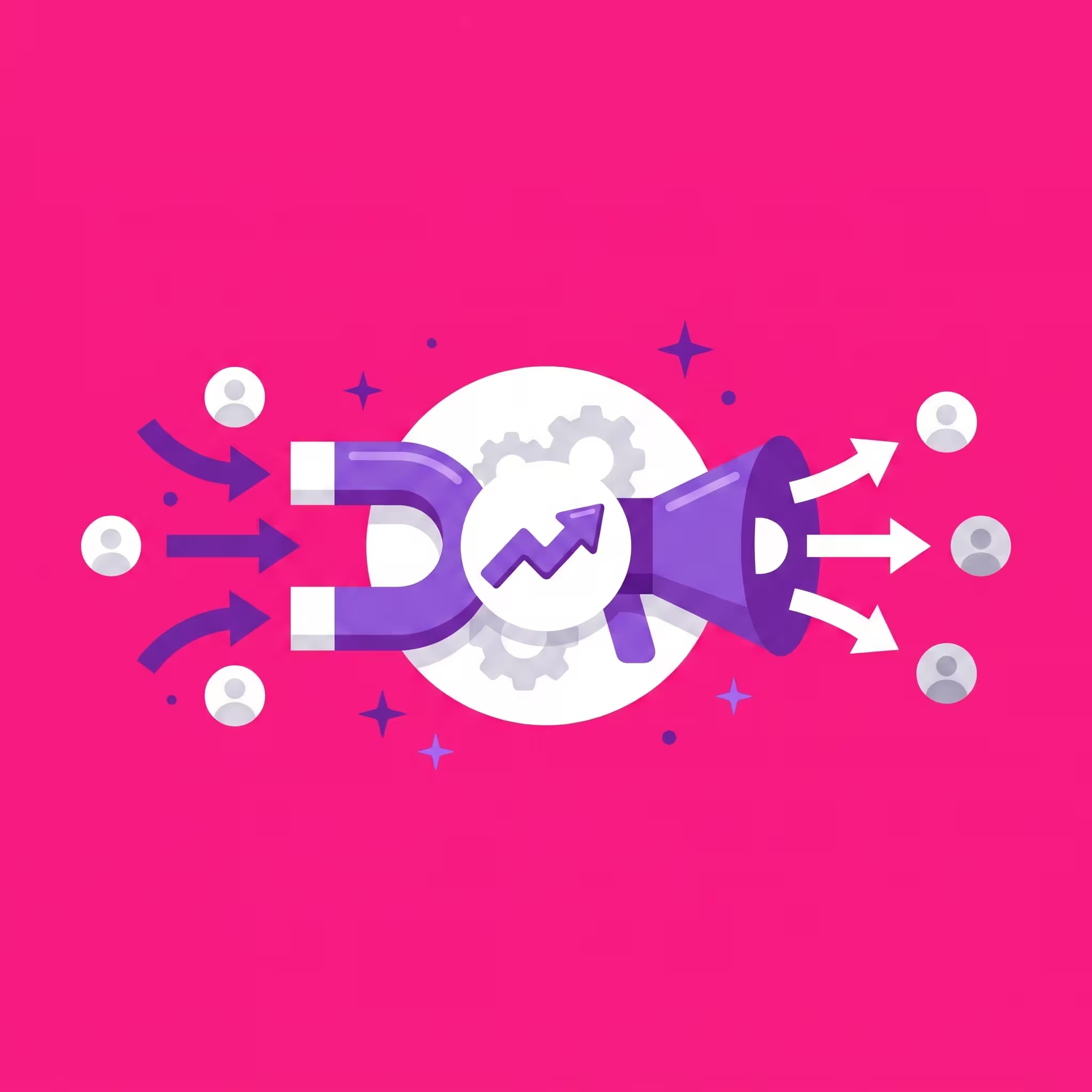

Inbound recruiting is a hiring strategy where candidates come to you — through job postings, career pages, employer branding, and referral programs. Outbound recruiting is a strategy where you go to candidates — proactively identifying, evaluating, and contacting people who haven't applied and may not be actively looking.
Both strategies work. Neither alone is sufficient. The question isn't which is "better" — it's which mix produces the best hiring outcomes for your specific situation, and how AI tools are changing the economics of each approach in 2026.
How Inbound Recruiting Works
Inbound recruiting relies on attracting candidates to your open positions. The core channels include job board postings (Indeed, LinkedIn Jobs, Glassdoor), your company careers page, employee referral programs, employer brand content (social media, blog posts, company reviews), and recruitment marketing (targeted ads driving candidates to your job listings).
Strengths of inbound recruiting. Candidates who apply have already self-selected — they've seen the role, evaluated the company, and decided they're interested. This pre-qualification means less time convincing candidates that the opportunity is worth exploring. Inbound also scales efficiently for roles with high application volume. And for companies with strong employer brands, inbound can attract world-class talent with minimal per-candidate effort.
Limitations of inbound recruiting. Inbound only reaches the 20-30% of the workforce that's actively job-seeking at any given time. The remaining 70%+ — passive candidates who aren't looking but would consider the right opportunity — are invisible to inbound strategies. Additionally, inbound creates a volume problem: a single job posting might generate 200+ applications, but studies consistently show that 75-88% of applicants don't meet basic requirements. Recruiters spend enormous time screening out unqualified applicants to find the qualified minority.
The screening bottleneck. This volume-to-quality gap is inbound's biggest operational challenge. Without AI, a recruiter manually reviewing 200 applications spends 20-30 hours just on initial screening — most of that time on candidates who aren't qualified. With AI screening tools, this bottleneck disappears. GoPerfect's inbound screening connects to 60+ ATS platforms through Merge and automatically scores every applicant 1-5 with explainable reasoning. Qualified candidates surface immediately; unqualified applicants are flagged without consuming recruiter time.
How Outbound Recruiting Works
Outbound recruiting flips the model. Instead of waiting for candidates to come to you, recruiters proactively identify, evaluate, and contact candidates — typically passive professionals who aren't applying to jobs.
The outbound workflow includes candidate sourcing (searching databases and professional platforms for people who match role criteria), evaluation and scoring (assessing each candidate's fit before reaching out), personalized outreach (writing messages that demonstrate understanding of the candidate's background), and multi-channel follow-up (managing sequences across LinkedIn, email, and SMS).
Strengths of outbound recruiting. Outbound reaches the 70%+ of the workforce that inbound misses — passive candidates who are often the strongest performers. It gives you control over candidate quality because you're selecting who to approach rather than filtering whoever applies. And for hard-to-fill roles (specialized skills, senior positions, competitive markets), outbound is often the only viable strategy.
Limitations of outbound recruiting. Traditional outbound is extremely labor-intensive. A recruiter manually sourcing, evaluating, and writing personalized outreach for 50 candidates might spend 15-20 hours per role — and that's before follow-ups and sequence management. This time cost has historically made outbound prohibitively expensive for all but the most critical roles. Additionally, outbound response rates with generic messaging are low (10-15%), making it feel inefficient when done poorly.
How AI transforms outbound. AI recruiting agents eliminate the time burden that made outbound impractical at scale. GoPerfect autonomously searches across 800M+ profiles, scores every candidate with explainable reasoning, and writes hyper-personalized outreach sent across LinkedIn, email, and SMS. What previously required 15-20 hours of manual work per role now takes minutes of recruiter time. And AI-personalized outreach achieves 2-3x higher response rates than templates, making outbound dramatically more efficient than the traditional manual approach.
The Real Comparison: Inbound vs Outbound by the Numbers
Candidate pool size. Inbound reaches the ~25% of professionals actively looking. Outbound reaches the full talent market, including the ~75% who are passive. For roles where the best candidates aren't job-seeking, outbound accesses a pool 3-4x larger than inbound.
Candidate quality. Inbound produces a wide quality distribution — many applicants with a small percentage being strong matches. Industry data shows 75-88% of applicants don't meet basic requirements. Outbound pre-qualifies candidates before contact, so the quality of the pipeline is higher from the start. GoPerfect customers report a 55% candidate acceptance rate through AI-powered outbound, compared to the industry inbound average of roughly 29%.
Time investment per hire. Inbound requires significant screening time (sorting through high volumes of mostly unqualified applicants) but minimal sourcing time (the job posting does the attraction). Outbound requires significant sourcing and outreach time but minimal screening time (candidates are pre-evaluated). With AI handling both inbound screening and outbound sourcing, the time investment for each approach drops dramatically.
Cost structure. Inbound costs are weighted toward job board fees, recruitment marketing spend, and ATS subscriptions. Outbound costs are weighted toward sourcing tools and recruiter time. Without AI, outbound is significantly more expensive per hire because of the manual labor involved. With AI tools, outbound cost-per-hire drops substantially — often below inbound when you factor in the hidden cost of screening hundreds of low-quality applicants.
Time-to-fill. Inbound is dependent on when the right candidate happens to apply — which is unpredictable. A posting might attract a perfect candidate in 3 days or take 60 days with no strong applicants. Outbound is more controllable — you're actively finding candidates rather than waiting. AI-powered outbound delivers initial shortlists in 1-3 days, making time-to-fill more predictable and typically shorter.
Best for. Inbound works well for roles with high brand recognition, entry-level positions with large candidate pools, and markets where your employer brand is a strong pull. Outbound works well for senior and specialized roles, competitive markets, passive candidate pools, and any role where the best candidates aren't actively looking.
Why the Best Teams Do Both
The inbound-or-outbound question is a false choice. The highest-performing recruiting teams run both strategies simultaneously, with AI handling the execution of each.
Outbound fills the quality gap. When inbound applications don't produce enough qualified candidates (which happens for 60-70% of roles according to recruiting surveys), outbound sourcing fills the pipeline with pre-qualified passive candidates.
Inbound fills the volume gap. For roles where you need many hires quickly (sales teams, customer support, seasonal positions), inbound job postings generate the application volume that outbound alone can't match.
Combined creates competitive advantage. When both channels feed into the same evaluation system, you get the best of both worlds: inbound applicants who are self-motivated and outbound candidates who are pre-qualified, all scored with the same AI criteria so you can compare them on equal footing.
GoPerfect is the only platform built to handle both inbound and outbound with a unified AI. Its outbound engine autonomously sources from 800M+ profiles, scores candidates, and sends personalized multi-channel outreach. Its inbound engine connects to 60+ ATS platforms via Merge and automatically scores every applicant against the same role criteria. The recruiter sees a single pipeline where inbound applicants and outbound-sourced candidates are ranked side by side with identical 1-5 scoring and explainable reasoning.
This unified approach eliminates the common problem of running two separate processes — one for applicants, one for sourced candidates — that produce inconsistent evaluations and fragmented pipelines.
Choosing Your Mix: A Framework
Your inbound/outbound ratio should depend on three factors.
Role difficulty. For roles that consistently attract strong inbound applicants (high employer brand, competitive compensation, common skill sets), weight toward inbound. For roles that struggle to attract qualified applicants (niche skills, senior levels, competitive markets), weight toward outbound.
Time pressure. When time-to-fill is critical and you can't wait for the right applicant to find your posting, outbound gives you control. AI-powered outbound delivers shortlists in days, not weeks.
Team size. Without AI, outbound requires significant recruiter time per role — making it impractical for lean teams with many open positions. With AI agents like GoPerfect handling sourcing and outreach autonomously, even a single recruiter can run outbound across 40-60+ roles simultaneously, making the strategy accessible regardless of team size.
A practical starting point: Run inbound (job posting + ATS screening) for every role as a baseline, and add AI-powered outbound for any role that doesn't produce enough qualified inbound candidates within the first 1-2 weeks.
Frequently Asked Questions
What is the difference between inbound and outbound recruiting?
Inbound recruiting attracts candidates who come to you — through job postings, career pages, referrals, and employer branding. Outbound recruiting proactively finds and contacts candidates who haven't applied and may not be actively looking. Inbound reaches the ~25% of the workforce that's actively job-seeking. Outbound reaches the full talent market, including the ~75% who are passive. In 2026, AI tools like GoPerfect handle both approaches: autonomously scoring inbound applicants from 60+ ATS integrations and outbound sourcing across 800M+ profiles with personalized multi-channel outreach.
Which is better, inbound or outbound recruiting?
Neither is universally better — the right approach depends on the role, market, and time pressure. Inbound works well for roles with high employer brand visibility and large candidate pools. Outbound works well for specialized roles, senior positions, and competitive markets where the best candidates aren't actively applying. The highest-performing teams combine both, using AI to handle inbound screening and outbound sourcing simultaneously. GoPerfect is the only platform that unifies both with the same AI scoring, so inbound applicants and outbound-sourced candidates are evaluated on equal footing.
How does AI change the economics of outbound recruiting?
Traditional outbound recruiting is labor-intensive — 15-20 hours of manual sourcing, evaluation, and outreach writing per role. This made outbound impractical for all but the most critical positions. AI recruiting agents eliminate this time burden: GoPerfect autonomously sources, scores, and contacts candidates in minutes. AI-personalized outreach also achieves 2-3x higher response rates than templates, making each outreach more effective. The result is that outbound becomes cost-effective for every role, not just the hard-to-fill ones.
What percentage of my hiring should come from outbound vs inbound?
There's no universal ratio. Start by running inbound for every role as a baseline, then add outbound for roles that don't produce enough qualified applicants within 1-2 weeks. For teams hiring primarily for specialized or senior roles, outbound might drive 60-70% of hires. For teams hiring for high-volume roles with strong employer brands, inbound might drive 70-80%. Track source effectiveness (quality and cost per hire by channel) and adjust your mix based on data.
Can one recruiter manage both inbound and outbound effectively?
With traditional tools, managing both strategies requires significant time and often separate workflows. With AI, a single recruiter can effectively manage both. GoPerfect connects to your ATS to automatically score inbound applicants while simultaneously running outbound searches across 800M+ profiles. Both channels feed into a unified pipeline with identical scoring, so the recruiter reviews one combined shortlist rather than managing two separate processes. Customers report that this unified approach allows a single recruiter to manage 40-60+ roles across both inbound and outbound.
Why choose between inbound and outbound when AI handles both? Book a demo to see how GoPerfect unifies inbound screening and outbound sourcing in one AI agent.

Start hiring faster and smarter with AI-powered tools built for success


